
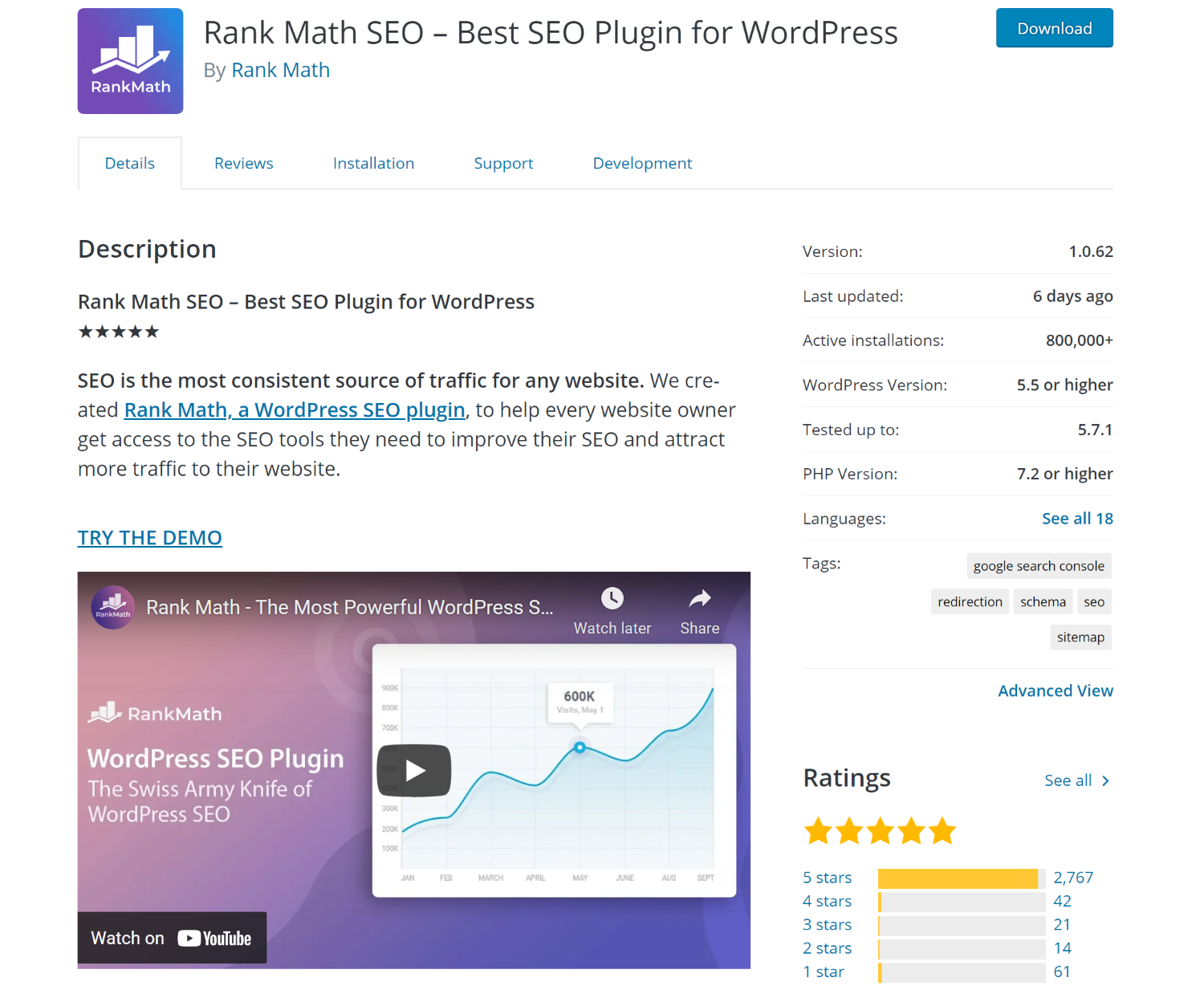
The Rank Math SEO plugin for WordPress is one of the newer SEO-focused plugins that is designed to help you ensure that your WordPress site or blog is listed properly in search engines like Google. While not nearly as well-known as competitors like the Yoast SEO plugin, it is gaining traction as an alternative to Yoast.
As of the date of this blog post, Rank Math SEO has been downloaded more than 800,000 times and has an overall five star rating with more than 2,500 five star reviews. That’s quite an endorsement from Rank Math users.
While Rank Math SEO is clearly a widely-adopted and appreciated plugin for establishing your SEO settings, the question is whether Rank Math SEO is a fast WordPress plugin or whether it could potentially cause negative speed impacts on your WordPress blog or website.
The question of “Is Rank Math SEO a fast or slow WordPress plugin” is exactly what our WordPress speed tests are designed to answer. Depending on the answer, it will be interesting to see how it compares to its competitors like Yoast and All-In-One SEO.
Our WordPress Plugin Testing Methodology
In order to determine whether the Rank Math SEO plugin could potentially slow down your WordPress site, we have designed a process to test the plugin for speed. Our goal is to provide fair and accurate testing that gives us baseline data to compare to.
We feel that first capturing baseline speed metrics of a bare-bones WordPress site allows us to effectively observe any negative speed impacts that occur when a plugin is installed and activated.
Our testing environment does not use any additional caching plugins or features, beyond what our host provides. We do not use any third-party Content Delivery Networks like Cloudflare and we don’t use any optimization features like script and CSS minification.
Essentially, our sandbox is a very basic WordPress implementation with a lightweight theme and no plugins other than the Classic Editor and the Rank Math SEO plugin.
Establishing The Baseline Sandbox Environment And Content
Our methodology creates a basic WordPress installation using the Twenty Twenty theme for testing purposes. We call this environment our testing sandbox.
With the sandbox environment, we create a single post that uses 800 words of Lorem Ipsum text and three appropriately sized images for the Web. Each of the images is 1920 pixels wide and 1280 pixels high and are resized by the theme to responsively fit the screen. We feel that a post with 800 words, one featured image, and three images accurately represents an “average” blog post that can be found on most WordPress sites.
Again, no lazy loading, image compression, or optimization has been done other than the lazy loading features offered by WordPress.
With the sandbox environment and test post in place, we first baseline the environment for speed to determine how fast the test post loads without the Rank Math SEO plugin installed. This baseline gives us the metrics to compare to once we install and activate Rank Math SEO.
To generate baseline metrics for the sandbox environment, we use multiple tests of three different speed testing tools.
- Google Page Speed Insights – We run the GPSI speed test five times and take the average scores of the five tests in order to determine the average desktop and mobile scores for the baseline testing post before the Rank Math SEO plugin is installed and configured.
- GTmetrix Speed Test – We run the GTmetrix speed test three times and take the average scores of the three tests in order to determine the average load time, page size, and number of requests for the baseline testing post before the Rank Math SEO plugin is installed and configured.
- Pingdom Speed Test – We run the Pingdom speed test three times and take the average scores of the three tests in order to determine the average load time, page size, and number of requests for the baseline testing post before the Rank Math SEO plugin is installed and configured.
With these baseline metrics captured, we have the necessary data to conduct the actual testing of the Rank Math SEO WordPress plugin.
The baseline data for the environment prior to installing and activating Rank Math SEO was as follows:
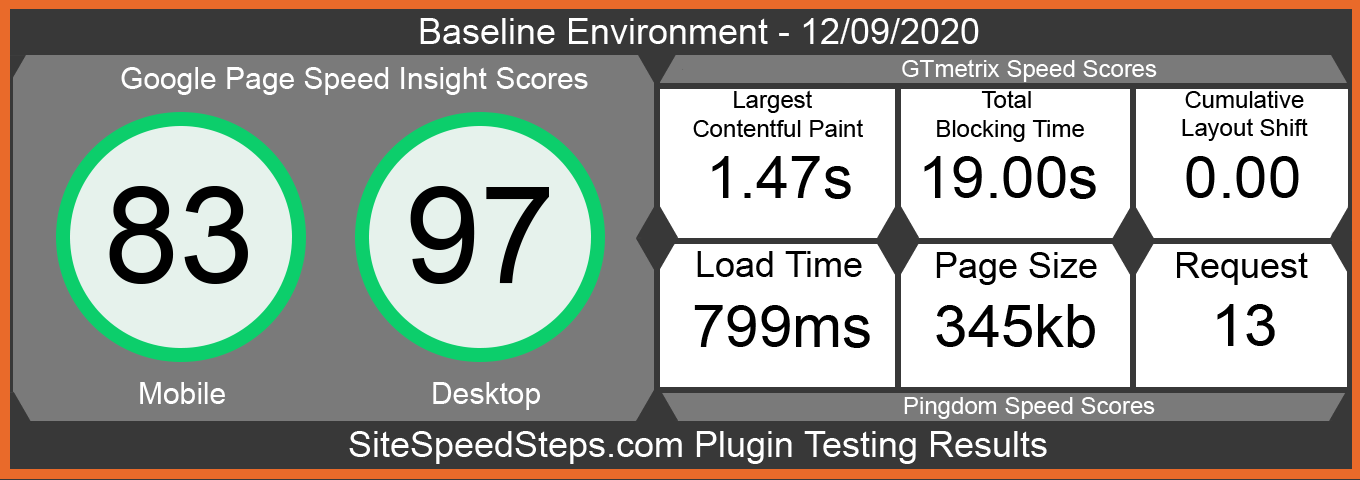
From the results, our sandbox environment was generating near-perfect scores via Google Page Speed Insights for desktop and an average score of 83 on mobile.
Using GTmetrix and Pingdom to test the post, we are able to discern that the page loads just over one second for the largest contentful paint and the total page size came in at 345kb.
Essentially, the blog posts loads very quickly across all three tests.
Installing And Activating the Rank Math SEO Plugin And Testing Any Site Speed Impacts
Once the baseline data has been captured, we proceed on to installing and activating the Rank Math SEO plugin from the WordPress plugin repository. For testing purposes, we left all the configuration as basic as possible.
For Rank Math SEO, that means we added the plugin but did not change any of the standard settings.
Using the same test post we leveraged to gather the baseline data, we followed the exact same data-gathering processes outlined above and gathered the resulting data.
By comparing the post-installation data to the baseline data, we are able to determine whether activating and configuring the Rank Math SEO plugin on WordPress has any negative speed impact on the testing post.
Results From The Rank Math SEO Plugin Testing
As seen in the testing results below, the Rank Math SEO plugin had nearly no negative impact on the Google Page Speed Insights Scores, the GTmetrix web speed test, or the Pingdom web speed test. The GPSI score averages did drop slightly and load time did increase a bit. Neither number, however, seems to be a cause for concern since the total load time still remained under 1 second and the load time at LCP was not significantly increased.
This is a good indication that Rank Math SEO operates as a lightweight, streamlined plugin and can be used without any concern of slowing down your WordPress site.

Observations Regarding The Rank Math SEO Plugin
Rank Math SEO is growing in its adoption as a WordPress SEO plugin and now we can rest assured that the plugin is not slowing down our WordPress sites
With respect to the Google Page Speed Insights scores, the average Rank Math SEO results were slightly lower than the baseline tests but still respectable. This indicates that Rank Math SEO will not significantly hurt your GPSI scores. Similarly, the GTmetrix and Pingdom tests demonstrated that there were virtually no measurable negative impacts caused by installing and activating Rank Math SEO to protect your WordPress blog or site from spam comments.
As a result of our plugin testing, we give Rank Math SEO the rating of:
 SAFE– This plugin causes no negative site speed impacts to a WordPress site. While it does not speed up your site in any way, it does not appear to slow down page load times significantly or excessively increase the number of requests made by a WordPress site. As a result, installing and using this plugin will likely neither increase or decrease your site performance.
NOTE: While a plugin may not cause negative site speed impacts, there are always possibilities that a plugin could conflict with other plugins or themes. Please test all plugins carefully to ensure that they work properly with your host, WordPress theme, and all other plugins.
To view our testing results sheet, you can download it in PDF format here.
Additional information that might be useful in your evaluation or our test results are as follows:
Test Date: 12-09-2021
Plugin Version Tested: 1.0.54.1
WordPress Version Used: 5.5.3
WordPress Theme Used: Twenty Twenty
WordPress Theme Version: 1.5
Hosting Used: Siteground GoGeek
URL Of Test Post: https://sandbox.sitespeedsteps.com/site-speed-steps-testing-post/
Number Of Words In The Test Post: 800
Number Of Images In The Test Post: 3+Featured image
If you have questions about our testing methodology or results, please feel free to reach out via our contact form